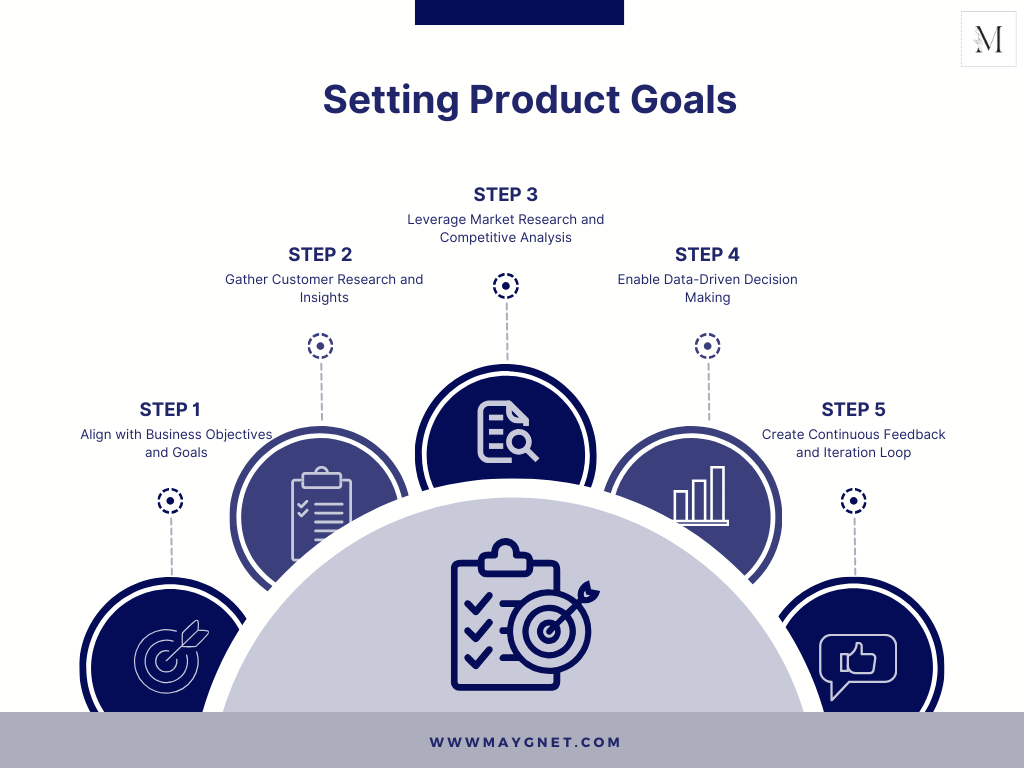
Setting product goals is an important part of the product management process. By following these tips, product managers can set goals that are aligned with the business, understand the customer, consider the competition, be realistic, and be measurable. Product goals should be SMART – Specific, Measurable, Achievable, Relevant, and Time-bound, to provide clear direction and ensure accountability. The goals should push the product forward while being realistic. Setting the right goals is crucial for focusing on product strategy and measuring success.
- Alignment with Business Objectives : Product goals should be aligned with the overall business goals of the company.
- Collaborate with key stakeholders, such as executives and business leaders, to understand the overall business objectives and strategy.
- Align product goals with these objectives to ensure that the product contributes to the success of the organization. This ensures that the product is working towards the same objectives as the rest of the business.
- Customer Research and Insights : Product managers need to understand the needs and wants of the customer to set effective goals.
- Conduct thorough customer research to gain insights into their needs, pain points, and expectations.
- Use this information to set product goals that directly address customer requirements and deliver value. This can be done through user research, surveys, and collaborative meetings.
- Market Analysis and Competitive Assessment : Product managers need to be aware of the competition to set goals that will help the product stand out.
- Analyze the market landscape and assess the competition. This includes understanding what features the competition offers, as well as their strengths and weaknesses.Identify market trends, growth opportunities, and areas where competitors are lacking.
- Set product goals that capitalize on these insights and differentiate your product from competitors.
- Data-Driven Decision Making : Product managers should leverage data and analytics to inform goal setting.
- Analyze product metrics, user feedback, and market trends to identify areas for improvement and growth. Set goals based on data-driven insights to drive measurable outcomes.Set Product goals that are realistic and achievable.
- Define specific, measurable, achievable, relevant, and time-bound (SMART) goals. Quantify targets for metrics like revenue, customer acquisition, engagement etc.
- Continuous Feedback and Iteration : Goals should be reviewed regularly to ensure that they are still relevant and achievable.
- Foster a culture of continuous feedback and iteration. Regularly seek input from customers, users, and internal teams to understand their evolving needs and preferences.
- Set product goals that reflect this feedback and support iterative development and improvement.
Product managers must set SMART goals aligned with business objectives, customer insights, competitive analysis, and data-driven decision-making. Goals should contribute to overall business success, address customer needs, stand out in the market, and be reviewed iteratively based on feedback for continuous improvement and relevance.
 Maygnet