
In the fast-paced world of product management, staying ahead of the curve requires a keen understanding of your product’s strengths, weaknesses, opportunities, and threats. One invaluable tool in this endeavor is the SWOT analysis. Let’s delve into the intricacies of SWOT analysis in product management and explore how companies can leverage this framework to innovate and develop new products effectively.
Understanding SWOT Analysis: A Comprehensive Overview
A S.W.O.T analysis is a strategic planning framework that stands for Strengths, Weaknesses, Opportunities, and Threats. It’s a simple yet effective way to assess your product’s potential in the market. By understanding these four key areas, you can make informed decisions about product development, marketing, and overall strategy. It is sometimes called situational assessment or situational analysis. This technique is designed for use in the preliminary stages of decision-making processes and is intended to identify the internal and external factors that are favorable and unfavorable to achieving the objectives of your venture or your project.
How to Conduct a SWOT Analysis for New Products
Here’s a breakdown of each element and how it applies to product innovation:

- Identifying Strengths (S):
Strengths refer to the characteristics of the business or project that give it an advantage over others.
Begin by identifying the inherent strengths of the product. This could include unique features, technological advantages, brand reputation, or existing customer base.
- What unique advantages does your product offer?
- Does your company have expertise in a specific area that this product leverages?
- Things your company does well
- Tangible assets such as intellectual property, capital, proprietary technologies, etc.
Example: A company known for its sleek and user-friendly design may be a strength for a new line of smart home appliances or electronics. Apple’s strength lies in its design innovation, brand loyalty, and ecosystem of products and services.
2. Analyzing Weaknesses (W):
Weaknesses are characteristics that place the business or project at a disadvantage relative to others. Weaknesses are internal factors that hinder the company’s performance and competitiveness.
Assess your product’s weaknesses or areas for improvement. This could include limitations in functionality, gaps in the product offering, or operational inefficiencies.
- Are there any limitations in your product’s functionality or design?
- Does your company lack resources or experience in a crucial area for this new product?
- Does your product have a clear unique selling proposition or differentiation?
- Do you have a competitive advantage over competition?
Example: A startup creating a fitness tracker might have a weakness in brand recognition compared to established competitors and limited resources.

3. Exploring Opportunities (O):
Opportunities are elements in the environment that the business or project could exploit to its advantage.Opportunities are external factors that present avenues for growth and expansion.
Identify external factors or market opportunities that the product can capitalize on. This could include emerging trends, market gaps, or changing consumer preferences.
- What are the emerging trends in your target market?
- Are there unmet customer needs your product can address?
- Is the demand shifting and new needs emerging for your products or services?
- Are there underserved markets for specific products?
Example: A company creating a language learning app might see an opportunity in the growing demand for remote education.
4. Assessing Threats (T):
Threats are elements in the environment that could cause trouble for the business or project. Threats are external factors that pose risks and challenges to the company’s success.
Evaluate potential threats or challenges that could hinder the product’s success. This could include competitive pressures, regulatory changes, or technological disruptions.
- Is there strong competition in the market?
- Are there any potential regulatory hurdles or technological disruptions that could impact your product?
- Are there any dependencies on external factors, obstacles and roadblocks?
- Any changing consumer sentiments, new emerging players and technologies?
Example: A company creating a new social media platform might face a threat from established giants with a strong user base.

Putting it all Together
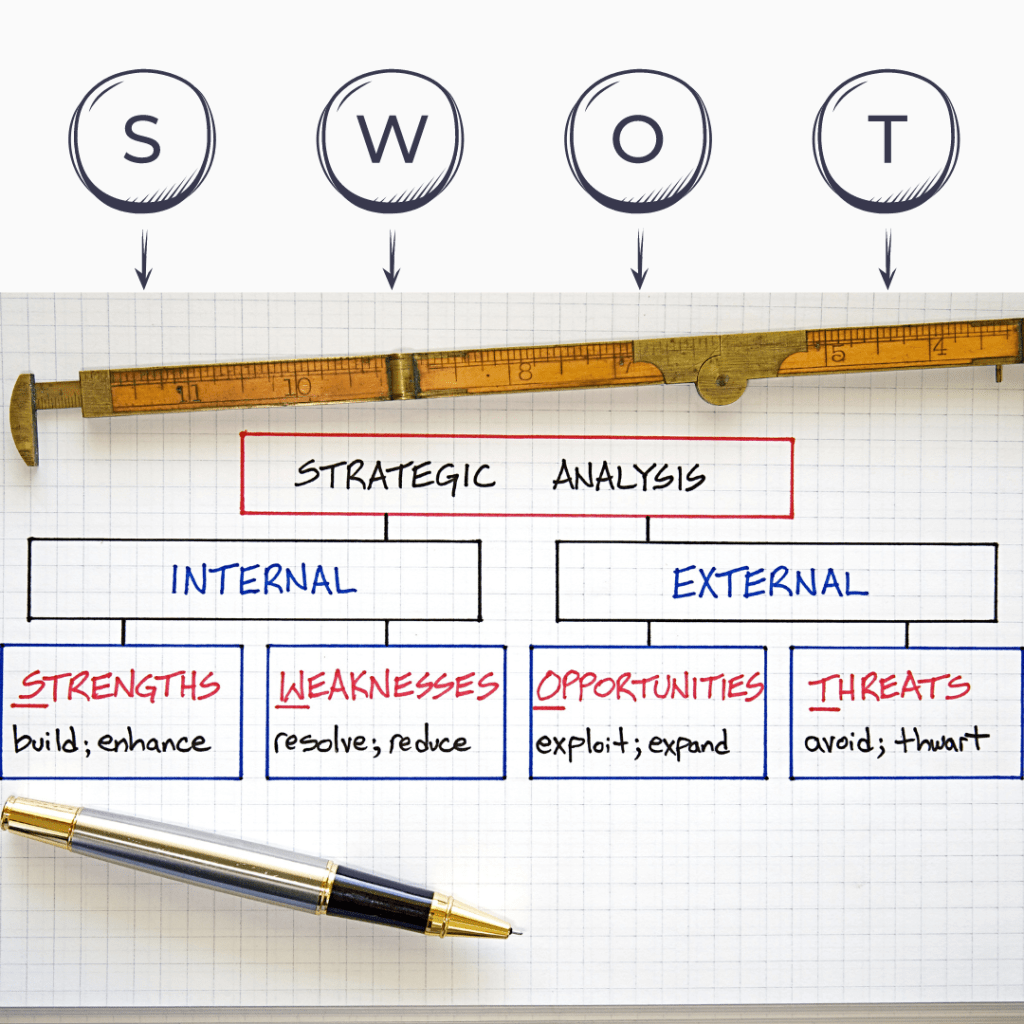
A SWOT analysis is a treasure trove of information, but the true magic happens when you combine these elements to craft a winning strategy for your new product. By strategically combining these elements, you can craft a roadmap that leverages your product’s strengths, addresses weaknesses, capitalizes on opportunities, and mitigates threats. Once you’ve identified your SWOT factors, the key is to analyze how they can be leveraged or mitigated. Users of a SWOT analysis often ask and answer questions to generate meaningful information for each category to make the tool useful and identify their competitive advantage. Strengths and weaknesses are considered internal factors while opportunities and threats are considered external. Combining the insights gained from strengths, weaknesses, opportunities, and threats (SWOT analysis) forms the basis for developing a comprehensive and effective strategy.
In strategy planning, the insights gained from SWOT analysis are integrated to develop a cohesive and actionable roadmap:
- Strengths are leveraged to capitalize on opportunities and mitigate threats. Strengths can be used to address weaknesses by allocating resources and efforts to areas where the company excels.
- Opportunities are identified and prioritized based on their alignment with the company’s strengths and goals. Strategies are developed to seize these opportunities and maximize their potential.
- Threats are assessed and strategies are devised to mitigate their impact. This may involve strengthening weaknesses to reduce vulnerability to external threats or proactively addressing emerging threats before they escalate.
- Weaknesses are identified and strategies are developed to address and overcome them. By addressing weaknesses, the company can strengthen its overall position and better capitalize on opportunities.
Strengths + Opportunities (SO Strategies): This is the sweet spot where you leverage your existing strengths to seize market opportunities. Here you can use your strengths to create a product that stands out from the competition, leverage your strengths to enter new markets or partner with other companies to amplify strengths and address opportunities.
A company with a strong brand reputation in athletic wear might use that strength to launch a new line of athleisure clothing.
Weaknesses + Opportunities (WO Strategies): Here, you focus on overcoming weaknesses to capitalize on market trends. You can allocate resources to address weaknesses that hinder your ability to capture an opportunity or outsource tasks where you have a weakness to free up resources and expertise.
A startup with limited design capabilities might outsource the design of its product packaging.
Strengths + Threats (ST Strategies): This combination is about using your strengths to mitigate potential threats from competitors or market changes. Here you can leverage your strengths to build a strong competitive advantage and focus on continuous innovation to stay ahead of the curve.
A company with strong manufacturing relationships might negotiate bulk discounts to offset potential price wars.
Weaknesses + Threats (WT Strategies): This area requires a defensive approach to minimize weaknesses and avoid potential threats. WT strategies comprises of developing plans to mitigate identified threats. It entails risk management, contingency planning and diversification.
A company facing a saturated market for its core product might explore diversifying into a related product category.
Tesla and Netflix are two real world examples of companies that leverage SWOT Analysis for Product Innovation. Tesla’s SWOT analysis revealed strengths in its innovative technology and brand appeal, but weaknesses in production scalability. Opportunities included increasing demand for electric vehicles, while threats included competition from traditional automakers. By leveraging its strengths and addressing weaknesses, Tesla continues to innovate in the electric vehicle market. Netflix identified strengths in its vast content library and data-driven recommendation system, but weaknesses in content acquisition costs. Opportunities included global expansion and original content production, while threats included competition from other streaming platforms. By capitalizing on its strengths and opportunities, Netflix remains a leader in the streaming industry.
SWOT analysis is a powerful tool that can empower product managers to make informed decisions during the crucial innovation stage. By taking the time to assess your product’s strengths, weaknesses, opportunities, and threats, you can increase your chances of bringing a successful product to market. A SWOT analysis is not a one-time exercise. As your product evolves and market dynamics shift, revisit your SWOT regularly to ensure you’re adapting your strategy accordingly. This technique is designed for use in the preliminary stages of decision-making processes and can be used as a tool for evaluation of the strategic position of organizations. SWOT has been described as a tried-and-true tool of strategic analysis but has also been criticized for its limitations, and alternatives have been developed to further enhance its capabilities.
 Maygnet