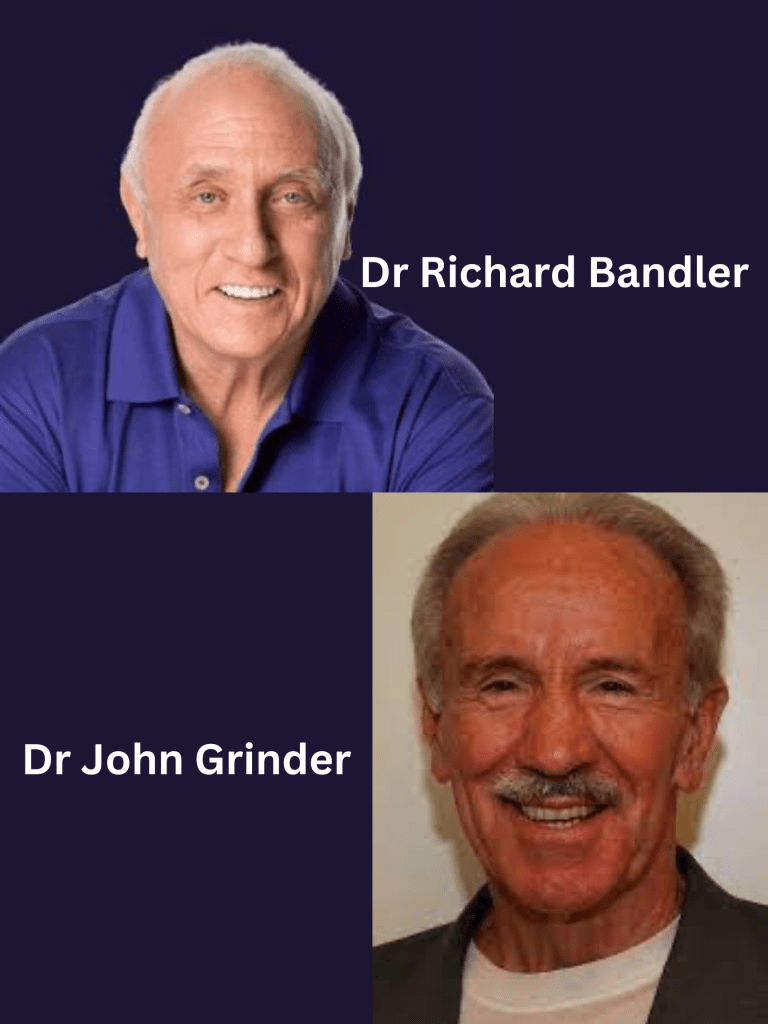
NLP emerged in the 1970s at the University of California, Santa Cruz. It was born from the collaborative efforts of Dr Richard Bandler and Dr John Grinder.
Dr. Bandler is a mathematician, a philosopher, a modeler, a teacher, an artist and a composer with a keen interest in human behavior. He has left a legacy of books, videos, audios, art, students and a body of knowledge that will change therapy and education as well as medicine forever.
Dr Grinder is the co-originator of NLP and one of the greatest thinkers of our lifetime. He has authored 14 books on complex subjects ranging from transformational grammar, family therapy and his very own creation of Neuro-Linguistic Programming.
Dr Grinder has devoted his life’s work towards his quest to uncover and present human patterns of excellence which have been modelled from geniuses in different fields. He created Neuro-Linguistic Programming with Dr Bandler, to investigate and replicate extreme human excellence.
They were driven by a fascinating question: What if we could decode the patterns of excellence in human behavior and teach them to others?
This quest led them to study the techniques of renowned therapists like Virginia Satir, Fritz Perls, and Milton Erickson.
The duo developed a special method called “modeling” which was basically figuring out the exact techniques these therapists used to help people. They wanted to break down these techniques and give them a structure so that other people could learn and use them too.
They published their work in the book called The Structure of Magic which is a two-volume book series published in (1975 and 1976). The series explores how humans construct internal models of the world through language and nonverbal communication.
Their goal was not merely to understand these strategies but to create a model that they could then replicate in others. They sought to identify the replicable patterns of thought, language, and behavior modeled after months of careful listening and transcribing the techniques used by Fritz Perls and Virginia Satir while they worked with their clients. Dr Bandler began to incorporate the speech patterns and mannerisms of these therapists into his own communication.
The big idea was simple: if you can understand the structure and techniques of how excellent therapists communicate with their clients, you can simulate those techniques to teach anyone to communicate more effectively and help people change their thinking and behavior.
 Maygnet